Essay
Critical Essay on Kenji Sakai
By Anna Moss
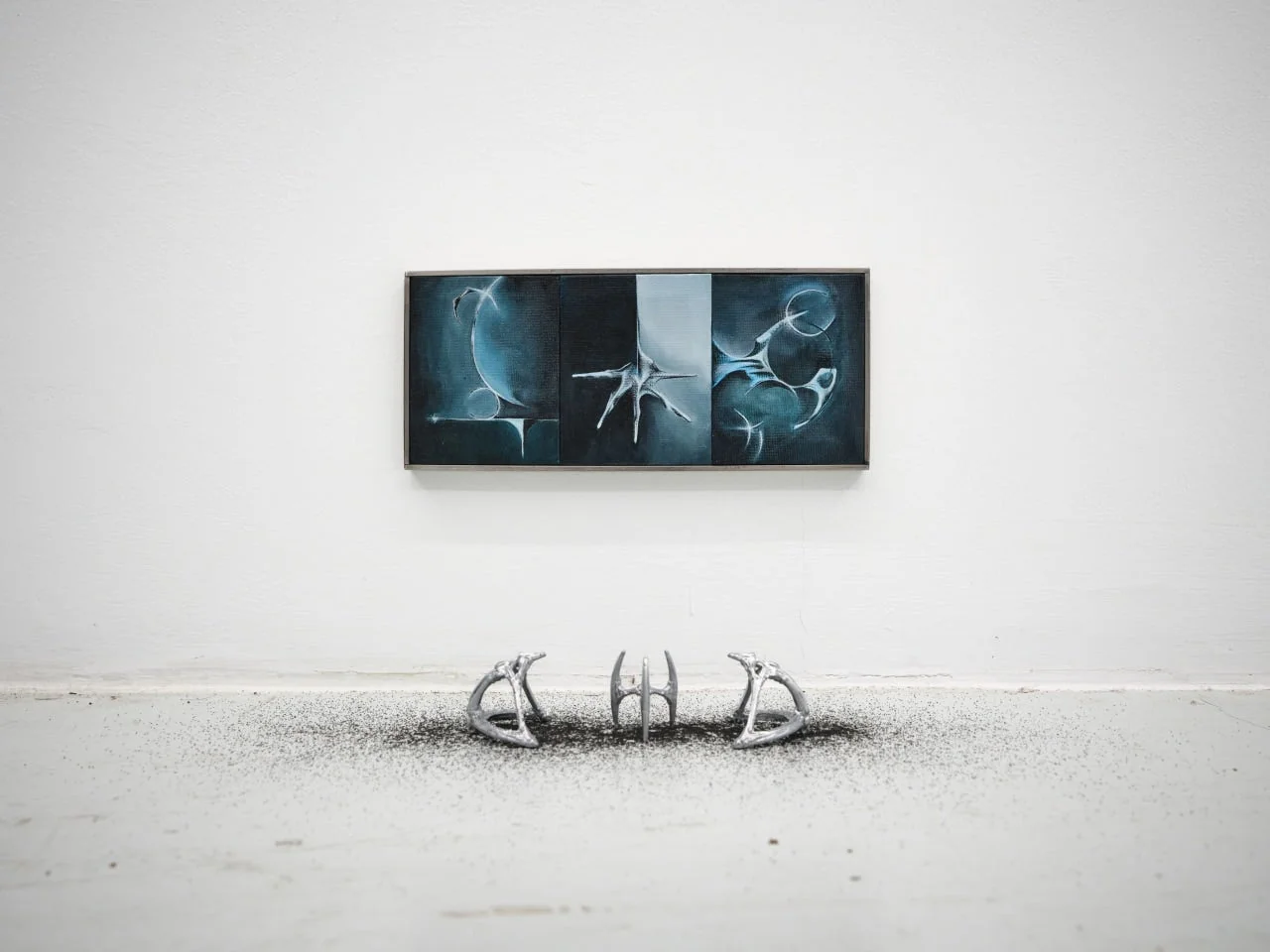
Artist and director of MATTER, Kenji Sakai, is led by a constant renewal and challenging of concepts rather than a set direction. His practice has taken him from Kyoto to Japan, and now London. He has explored drawing, printmaking, painting and sculpture, also working alongside artists in his capacity as a curator. These broad-ranging personal and professional experiences have infused his work with similarly diverse ideas. The themes that underpin Sakai’s work include the individual and society, harmony and discord and the natural world. A closer look at the artist’s oeuvre reveals that these facets are often deeply intertwined: that a natural object such as a stone thrown into a body of water, can represent human action and emotion.
Sakai’s paintings are often distinguished by their seemingly chimerical appearance. Sharp angles collide with softer forms, created by the artist’s strong draughtsmanship. The hybridity of his shapes evoke both the natural and unnatural. Sometimes they might resemble bats, unearthly bodies or mechanical instruments. Due to their unique composition, works like Wings of Shadow I (2026) appear to have no fixed orientation. Bodies are suspended, just out of reach. Lines travel in multiple directions. Sakai creates a space for viewers to contemplate, a way to reflect upon our world by envisioning another. For the artist, formative experiences in childhood have left an important mark on the artist’s approach to creation. He remembers deep fears of his own mortality as a child, as well as strange moments of self-consciousness during physical accidents. With these anxieties, the young Sakai tried to imagine what lay beyond his own body, in boundless space beyond immediate experience. He began to consider these questions not just in his head, but on paper. What does the immaterial world look like? What does infinity look like? Sakai ultimately imagined a world of hinkai (森海), combining the Japanese characters for ‘forest’ and ‘sea’. Together, this sense of depth, darkness and the unknown merged into one. Although he was drawing the unfamiliar, even the eerie — the very process of confronting this through drawing aided the artist’s anxiety. For Sakai, drawing is a responsive process. Each mark informs the next, influencing the outcome in small stages. Indeed, the idea that drawing is itself a cognitive process is outlined by philosophers Andy Clark and David Chalmers in their seminal work ‘The Extended Mind’.
In Sakai’s present day practice, existential questions still permeate both his work and exhibitions. And just like his earlier approach to drawing, he does not seek to neatly resolve these highly complex questions, but rather to explore them through natural imagery and metaphor. Water is a particularly generative theme, visually and conceptually, as exemplified in Sakai’s exhibition, Surface Tension of Blue. The exhibition’s premise is a moment in which the stillness of a lake is disturbed by an external force. In the artist’s own words, ‘surface tension represents the invisible boundary between a fragile yet seemingly stable order and an underlying sense of unease that could rupture at any moment’. The series of four eponymous paintings reveal delicate, ghostly ripples that traverse across the canvas. Seen as a body of work, one understands how narrative decisions turn to subtle, material transitions. Across each painting, Sakai’s lines become more sprawling and his palette lightens from midnight blue to glacial tones. These effects conjure the impression of dual forces: darkness and light working together, calmness and disorder interacting. The beauty of these paintings and the exhibition’s wider concept is that the rupture in the water can have a multitude of causes. Figuratively speaking, it can allude to war, disaster or heartbreak. The potential for interpretation within Sakai’s analogy feels limitless. And with this comes a sense of open-mindedness towards negative emotions. The darker, murkier brushstrokes in Surface Tensions represent a ‘stirring up’ of sediment, of tensions previously unacknowledged.
Sakai’s subjects have a certain universal character. Wielding the visual language of abstraction, his narratives grapple with profound problems without imposing upon their viewer. They evade site specificity, instead focussing on the aforementioned sense of what is beneath and beyond our surroundings. Yet, as an artist-curator working across continents, the question of cultural differences between Sakai’s native Japan and current residence in England emerges. Many of Sakai’s works investigate the idea of the individual and collective. His abstract forms in this context function as experiments in proximity. This becomes most prevalent in his recent work, Held in Place, which is defined by its multiplicity. Each work is a triptych, featuring single forms as they bend, glide and stretch as if they were alive: perhaps small creatures or cells within the body. This sense of gesture is offset by the sense that these distinct forms are fixed in position through their containment as one. Literally framed together in steel, each unit gains its impact by functioning as a larger whole. For Sakai, this way of thinking about relationships is distinctly Japanese: the sense that people define themselves through their relationships.
Held in Place was recently exhibited at Minor Attractions in London, a fair at The Newman Hotel that ran during Frieze week. Across the rooms of the hotel, different galleries nationally and internationally exhibit work in dialogue with the surroundings. Work is placed on bathroom sink tiles, hung around TVs and above beds. Sakai both curated and exhibited work as director of MATTER, sharing the room with Rotterdam-based gallery, CONTOUR. All in all, the room displays twelve artists from different nationalities and backgrounds. Their work is beautifully curated through formal relationships, though their concepts differ. With Sakai, MATTER prioritises community over commercial incentive: ‘I wanted to create something that moved at a different pace from the fast art market. I wanted it to be an experimental space, where things don’t necessarily need to produce immediate results.’ Looking at Held in Place once more, it appears rather like a microcosm for artist collaboration. Something different slowly emerges through the participation of each person within a unified group.