Essay
A woman held
Joséphine May Bailey on CAMEO, Lucy Cade’s solo exhibition at Fitzrovia Gallery, curated by Alinda Kring.
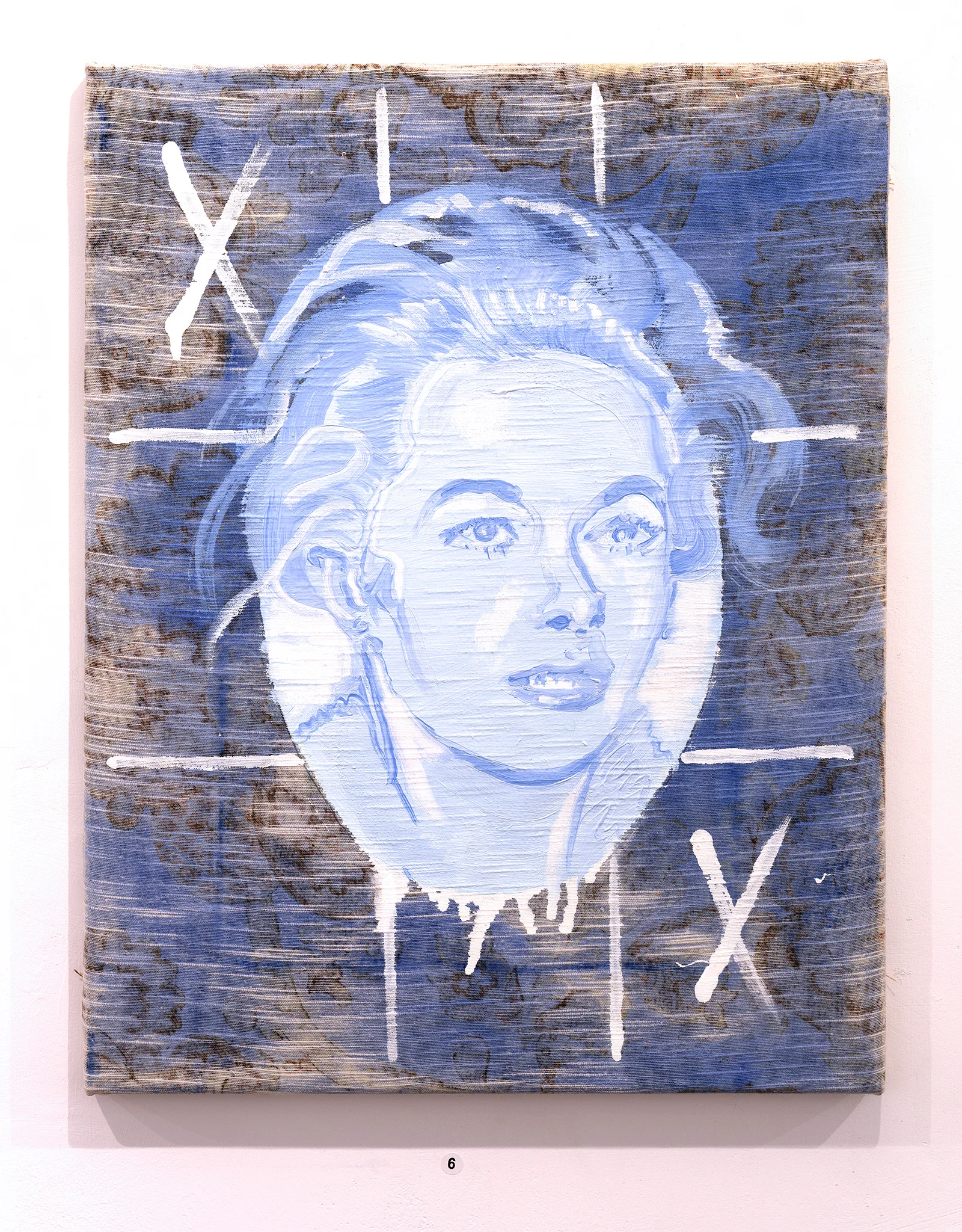
CAMEO is Lucy Cade's solo exhibition of paintings and drawings at Fitzrovia Gallery, curated by Alinda Kring. Most of the work was made in the last two years; it looks at the ways women have been pictured, in paint and on film, from Hollywood actresses of the Hitchcock era, painted from stills of their films, to poets and artists history has been slower to remember. Lucy sets each of them inside a frame she has made her own.
I have known Lucy's painting since 2022, when she showed Bedside manners in I Felt That, a project I curated in Hackney. Those four blue canvases came out of her experience of postnatal psychosis; the women in them posed like studio stars against a hospital blanket on a ward. It was work of real candour, and CAMEO carries the same pairing of glamour and private struggle into the cinema.
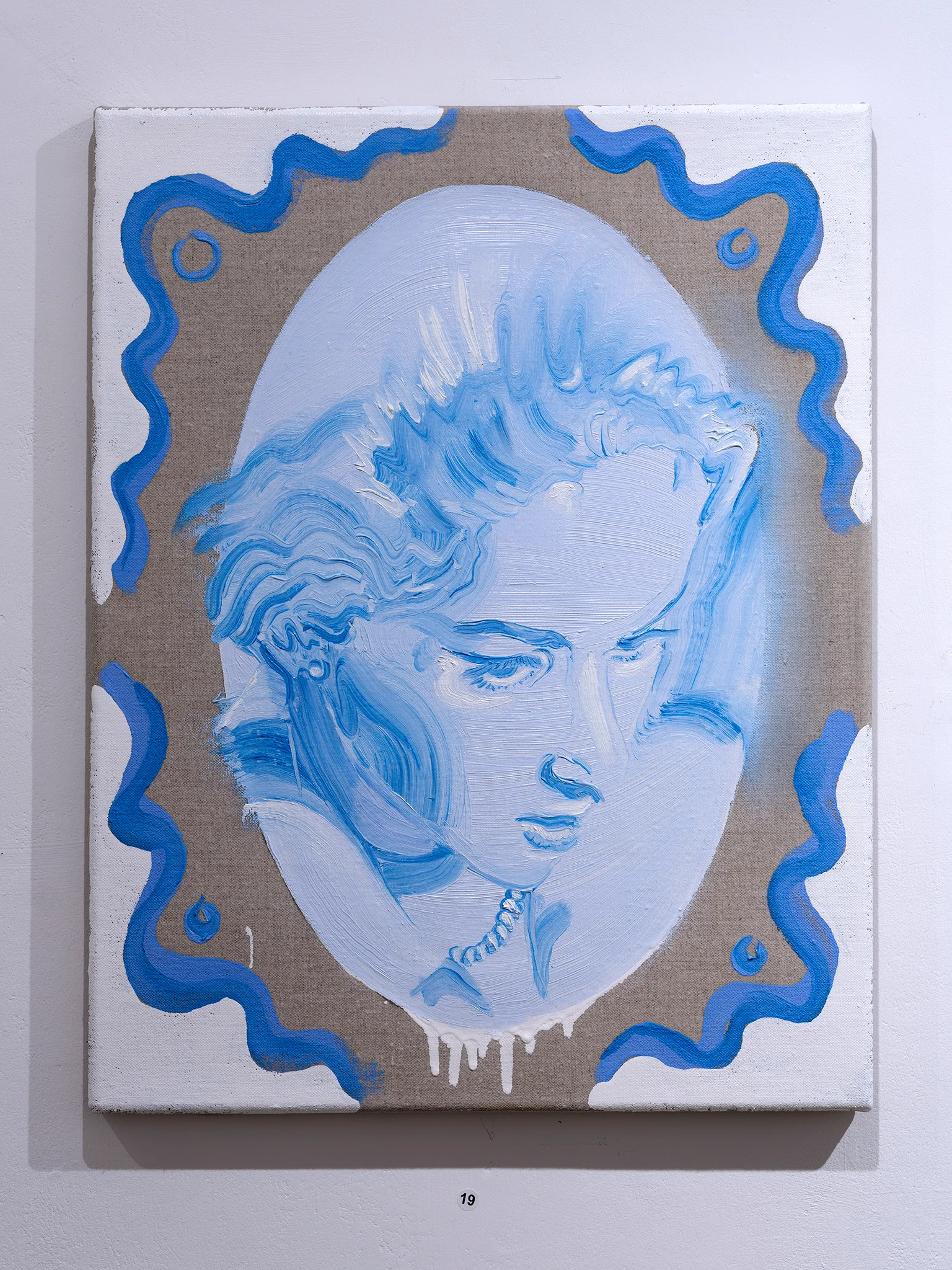
The frame is the oval. It rings, in varying forms, every face she paints, like a locket left open. She chose it, she says, because it is more human than a rectangle, a form with no corners and no point at which it stops. Every woman here is held in one; CAMEO is about the different ways a woman can be held: kept close, kept still, kept out, and sometimes holding herself.
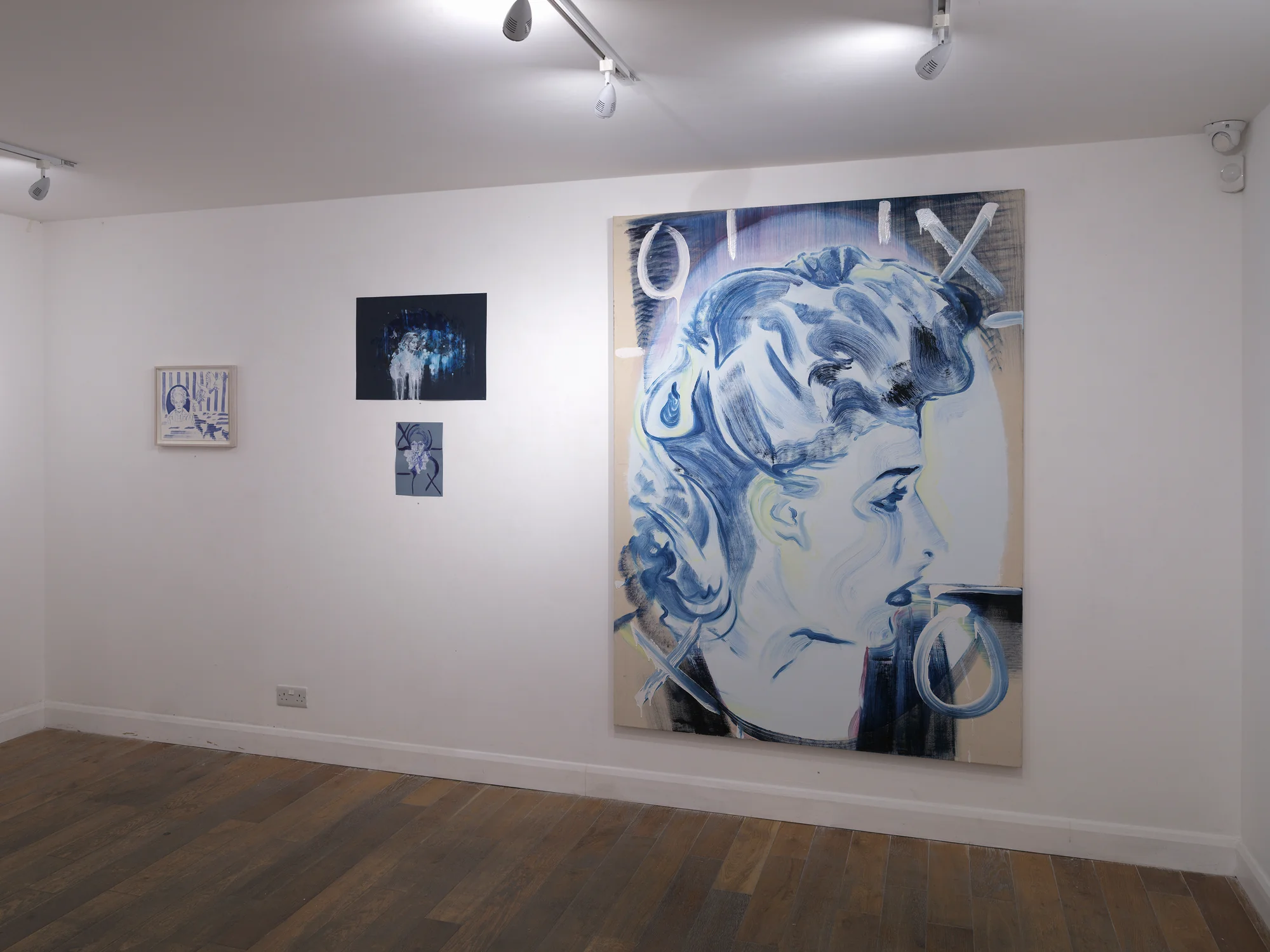
The palette is held back too; it draws on the black-and-white history of cinema in a way that is strange, and a little flattening. Faces are drawn in cobalt and white, cool as a negative lifted to the window, with a flush of pink where the oval meets the ground. Lucy calls this the tonal economy of old film; with so little colour to look at, I find myself watching the paint instead: the soft blooms where one wet stroke has bled into the next, the drips she lets run from the base of an oval and then leaves alone. The blue has a history of its own. When Josiah Wedgwood perfected his jasperware in the 1770s, with white classical reliefs, some modelled by the young John Flaxman, raised on a pale blue ground, he brought the cameo out of the collector's cabinet and into the ordinary home. Lucy's blue sits somewhere between that keepsake and the cinema screen.
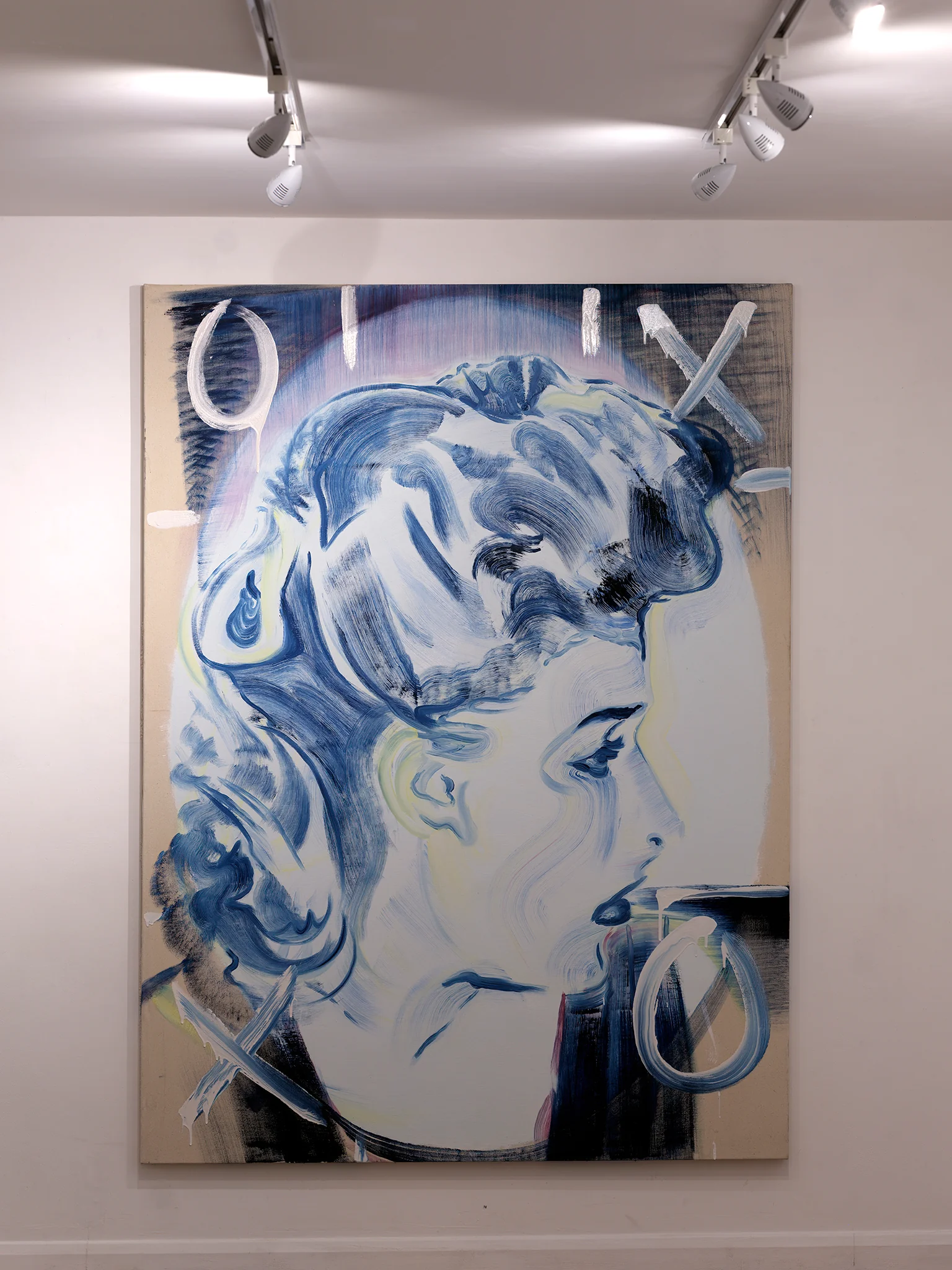
In Xs & Os two women sit side by side in two ovals on a dark grid marked with a nought and a cross. Lucy calls the ovals devotional, a way of lifting a figure out of a film's plot and holding it still, as an icon holds a saint. The game pulls the other way; noughts and crosses allows so few moves that, played well, it always ends in a draw, and for Lucy that is the measure of the roles these women were offered. Opening Move, the largest painting in the show, takes Ingrid Bergman in Hitchcock's Spellbound (1945). Lucy sees a woman hemmed in by demands on screen and off it. In the film she plays a psychoanalyst her colleagues think cold, until love is offered as the cure; beyond it, she was bound to the wholesome image her studio had built for her. The O repeats the oval and the X strikes through it, yet the paint goes on in thick, striated strokes and Bergman comes through vivid and entirely sure of herself. Classified goes further; Lucy calls it an expression of not playing by the rules.
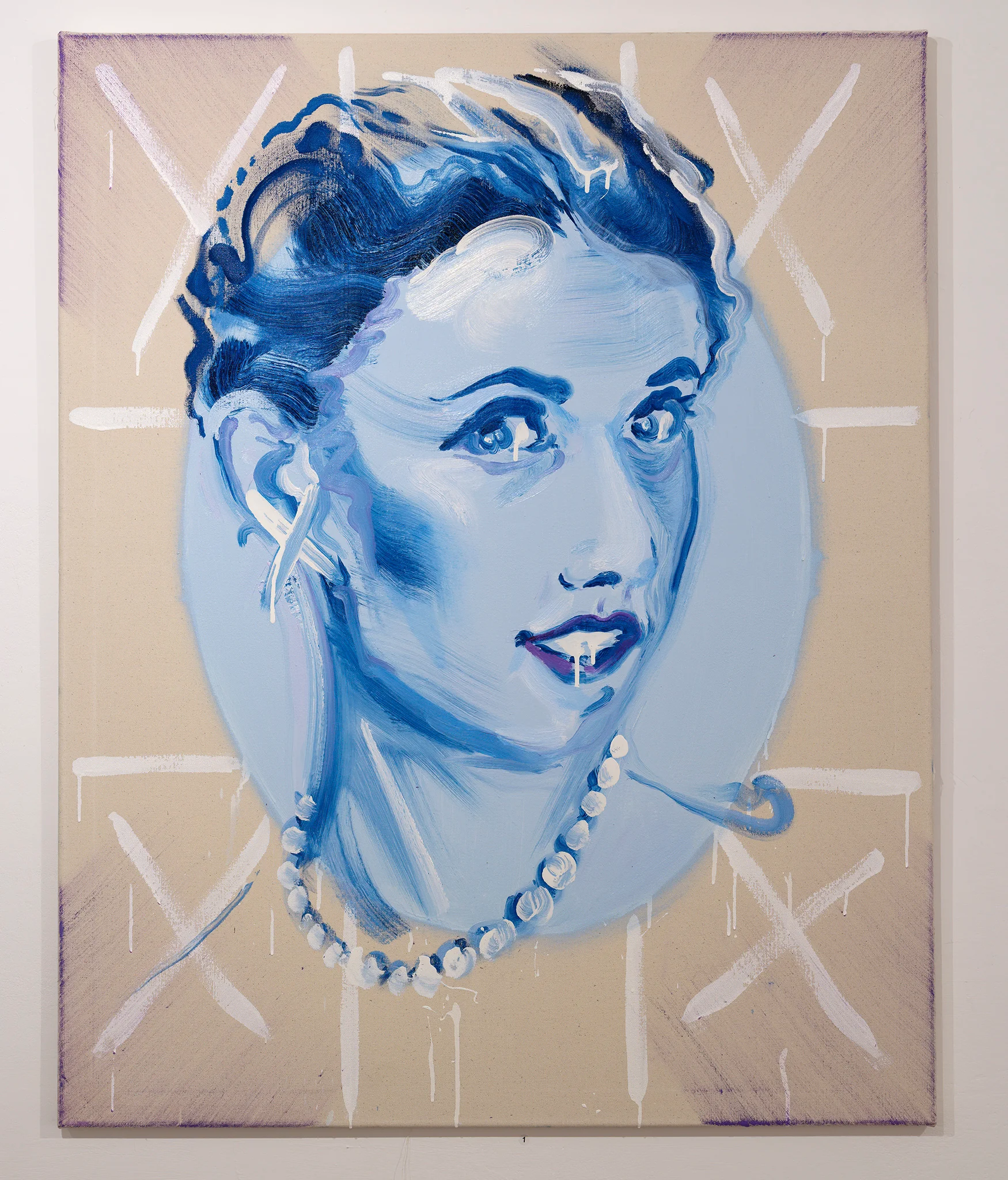
The oval has always been the shape of keeping someone close. Roman cameos carved a face into layered stone, to be worn against the body. Nicholas Hilliard's miniatures, painted for the Elizabethan court, were small enough to shut inside a locket and open again in private. In the 1780s the lover's eye pared the beloved down to a single painted eye, pinned to a brooch so that only the wearer knew whose gaze it was. The fashion is often traced to the Prince of Wales, who sent Maria Fitzherbert a miniature of his eye when their marriage had to be kept secret. Victorian photographers later masked the family portrait into the same oval, for the mantelpiece and the album. These were faces made to wear and give away, and very often they were women's, kept by someone else.
The same format could keep women out. In Johann Zoffany's The Academicians of the Royal Academy (1771-72) the members crowd round a nude model in the life room. Angelica Kauffman and Mary Moser, the only women among the founders, hang on the wall as oval portraits, because women were barred from drawing the nude. They are there as faces, never as members at work; no woman would be elected a full Academician again until Laura Knight in 1936.
A cameo is, of course, also a brief appearance by someone famous, with Hitchcock making it his signature, slipping into almost every film he made. In The Birds (1963) he walks out of a pet shop with his own two white terriers just as Tippi Hedren walks in; Hedren walks through this show too. She later spoke about the control Hitchcock held over her career, and I Free Myself (Across The Marshes) draws on the life she made for herself afterwards, at the wildlife sanctuary she founded in California, with lions that had once lived in her family home. Lucy finds the same pull towards wildness and open country across her roles. Still Life with Dead Swans takes the film's terror and lays it to rest; the birds become a tame, decorative display, closer to the hanging game of a Dutch still life than to anything that might strike.
In Vertigo (1958), Kim Novak's Madeleine is first seen in profile at a restaurant table; later, she sits in a gallery before a painted portrait, as still as the woman in its frame. In 'Visual Pleasure and Narrative Cinema' (1975), Laura Mulvey drew on Hitchcock to describe how classical film builds a woman to be looked at, and that profile is the cameo in its screen form. Lucy's sketch after Madeleine, The Bridge Between, also draws on Jennifer Higgie's The Other Side, her history of women artists and the spirit world. Lucy calls it a kind of witnessing, a way of turning her back on how women of the past were treated while keeping faith with the women themselves.
So the oval holds two kinds of cameo. One is held in the hand by a single person; the other is thrown many feet high, in front of millions. Lucy takes the star's face, made by the Hollywood studios to be seen by millions, and returns it to the scale of the keepsake, something one person might hold. In Sleep My Love, after Douglas Sirk's 1948 film, Claudette Colbert plays a wife whose husband sets out to convince her she is losing her mind. She needs him and is limited by him, and Lucy calls the oval her cage. It can be read the other way, though; a boundary can be chosen. The oval can be somewhere a woman holds herself, rather than a frame put round her, and that is the reading I keep coming back to.
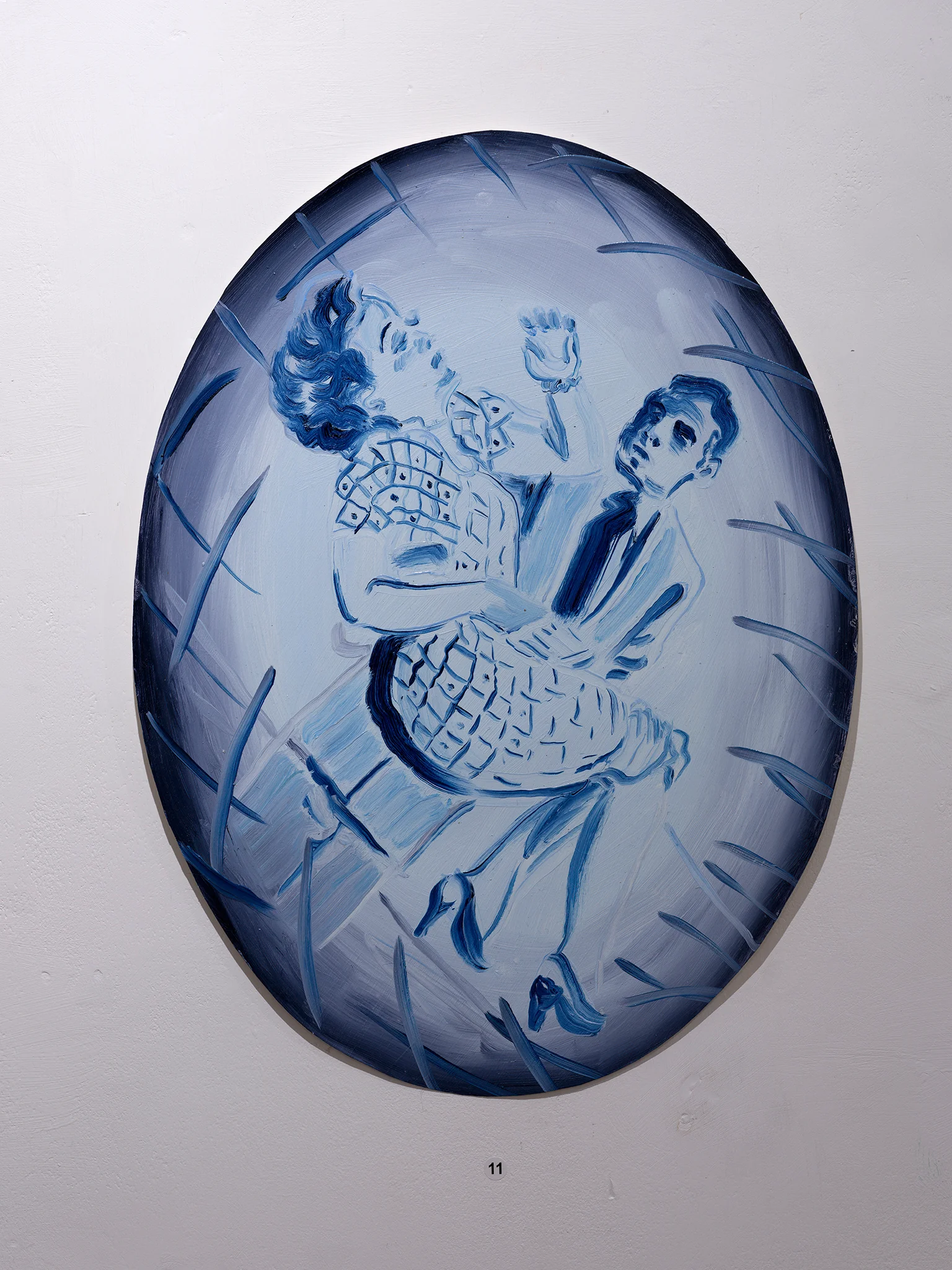
Where the palette changes, the subject changes with it. In Two Minds is painted on found patterned polycotton, with swirling ovals floating over a rigid grid and an acid yellow-green bleeding into the blue, so that the woman inside seems caught between two positions. Magnolias (Portrait of Nina Cust) leaves Hollywood altogether. It is painted on found pink satin finished with curtain tassels, chosen to recall the wallpaper of the rooms Cust lived in. Nina Cust (1867-1955) was a sculptor and a poet. Her collection Not All the Suns gathers the poems she wrote between 1917, the year her husband died, and 1944. Many of them are about flowering trees; towards the end of her life her house in London was said to be overrun with them, and the cycles of their flowering gave her a way to write about life's light and shade. In The Magnolia Tree she stands entranced beneath 'white-cupped ghostly boughs', whiter than the moon, until 'strange darkness grew'; the brightness and the dark are held in the same few lines. Cust makes everything sound cosmic, and Lucy builds the portrait in the same spirit, as a constellation of circling ovals, forms and angles.
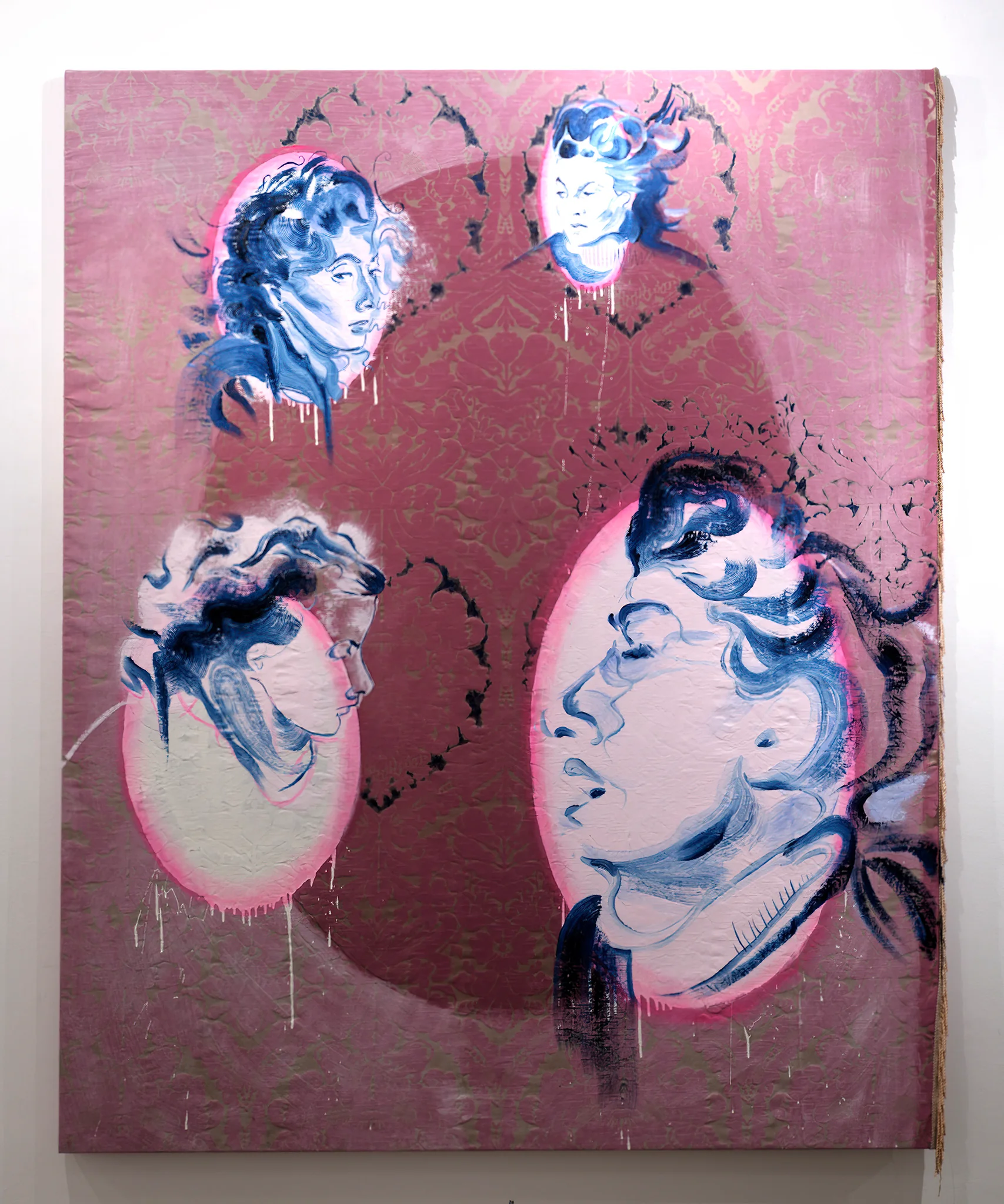
Lucy has named another painting, Not All The Suns, after the title poem, her favourite in the collection. It moves past Arcturus, Vega and 'great Betelgeuse', past 'aeons undreamed, dead centuries of years', to the one thing none of them can match: 'the small persistent passion-laden spark / Of man's high courage, burning through the dark.' Lucy would change one word, and read it as woman's courage. Cust lived on through the loss of a child and her husband's early death, and in her sculpture she memorialised both: a portrait bust in stone that carries her own grief, and a life-size stone effigy of her husband, which still lies in a church not far from Lucy's home. Lucy's work, keeping the lives of women from the past alight, runs parallel to hers.
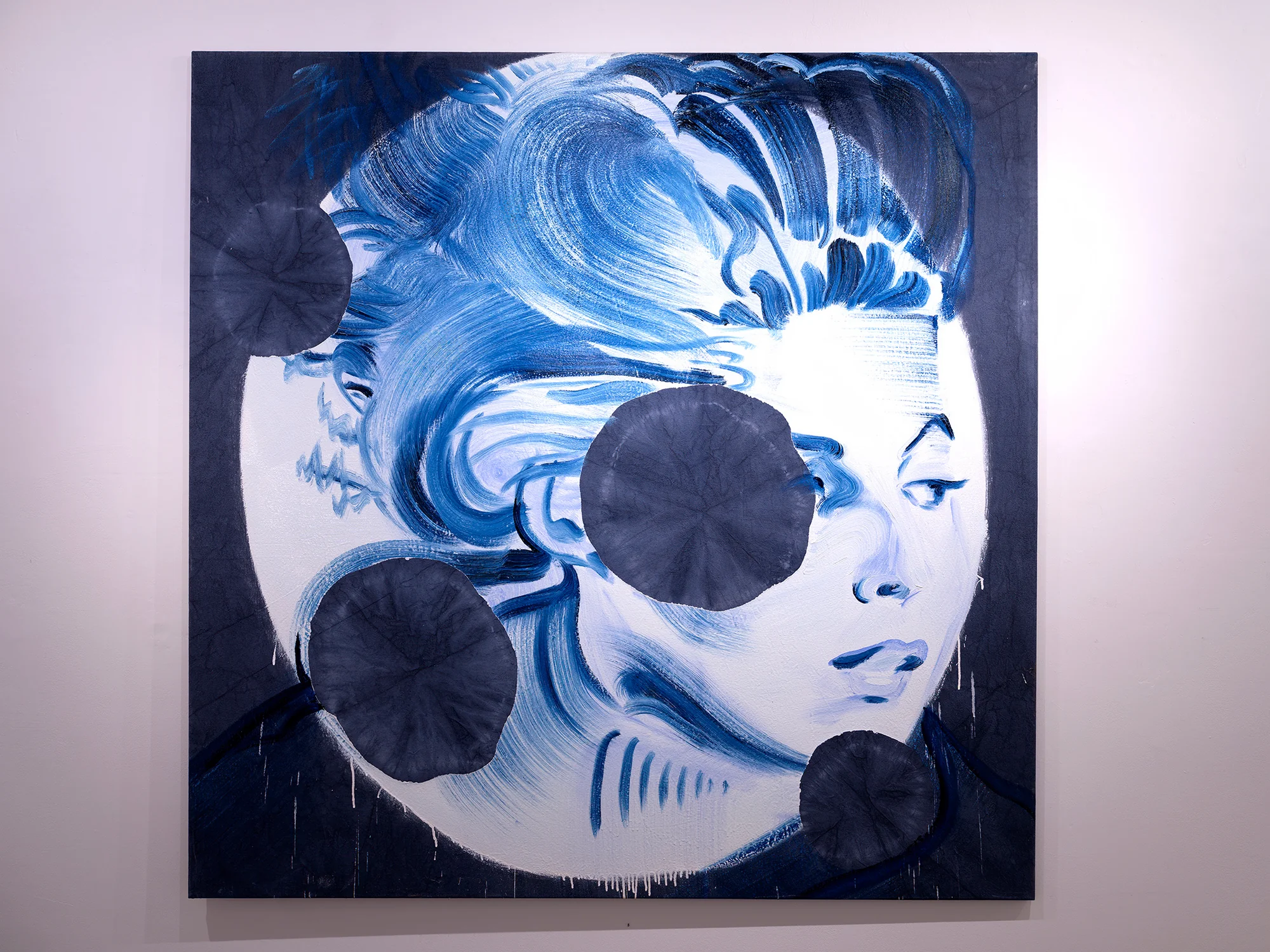
Lucy does not leave herself out; in I Reflect On You she turns the same scrutiny on herself, painting a clear oval over her own face and leaving it to drip. She calls it a mythologising in progress, the artist caught in the act of making a woman into an image, even when the woman is her.
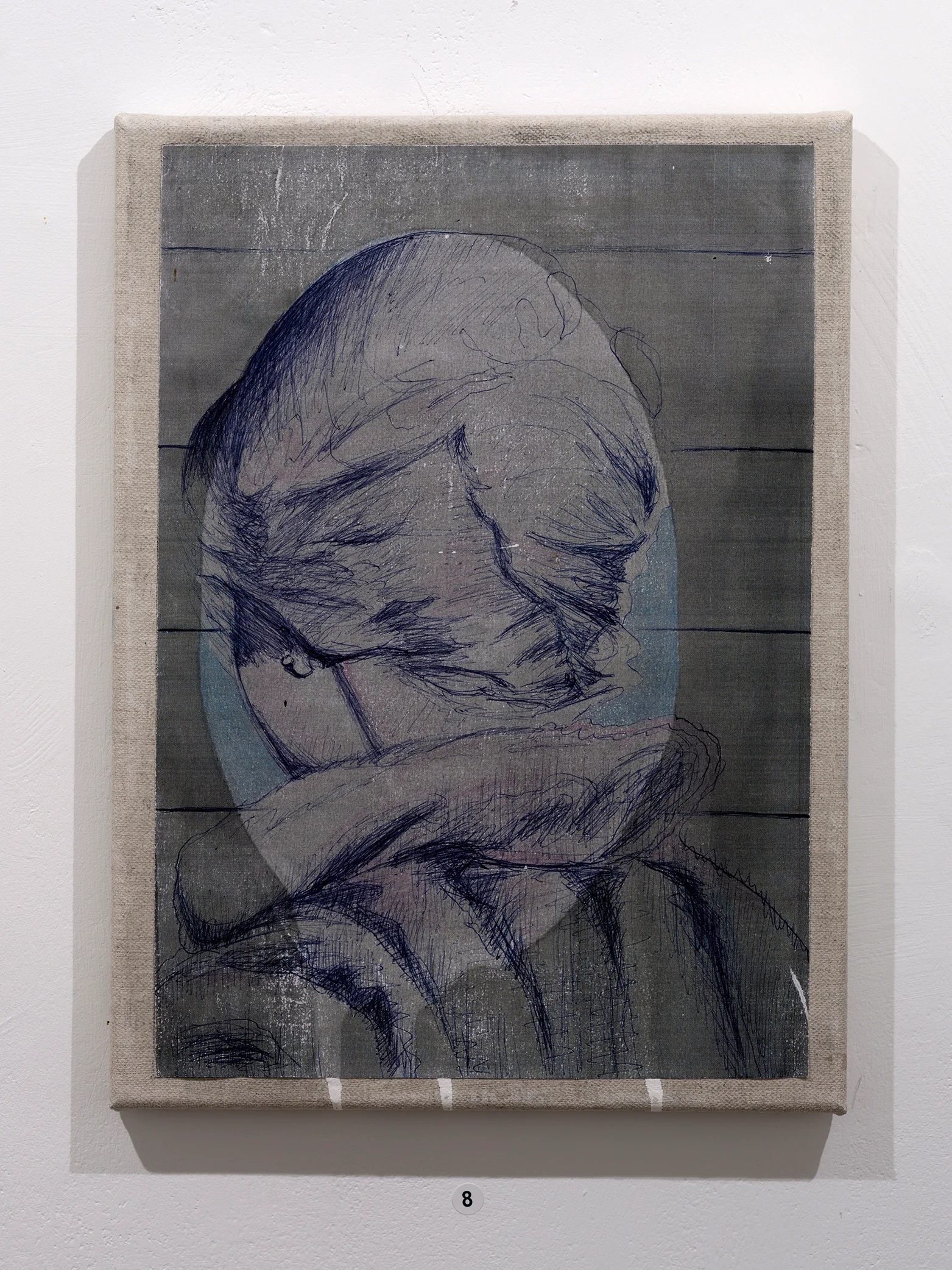
A small drawing, The Blue House, holds the whole show in miniature. It began as a daily progress photograph from the studio, a glossy white painted oval on grained wood, printed as a monochrome laser copy and worked over with biro and coloured pencil, the everyday materials of the home, before it was mounted on linen and carried back to the studio. Lucy names it after the imaginary place she keeps between her garden barn studio and her family home; the oval passes between the two, between the painting and the life around it. With the work together in one room, what strikes me most is how much feeling her women are allowed to keep. Kauffman and Moser hang on Zoffany's wall with no say in how they are seen; Lucy's women are still inside the oval, but they look out of it, and the paint around them stays loose and open, as though it had only just been laid down.